Want to add something fresh to your game but can't ship a major update every month? Start with a small seasonal event built on mechanics your players already know. It's a cheap way to check whether your audience is still alive — and the first step toward systematic LiveOps without rewriting the game.
Take an obby — a parkour game full of obstacles. It's a clean way to show the principle: an event changes the wrapper and the goal, not the rules. Running and jumping stay the same, while a festive route and a clear reward layer on top.
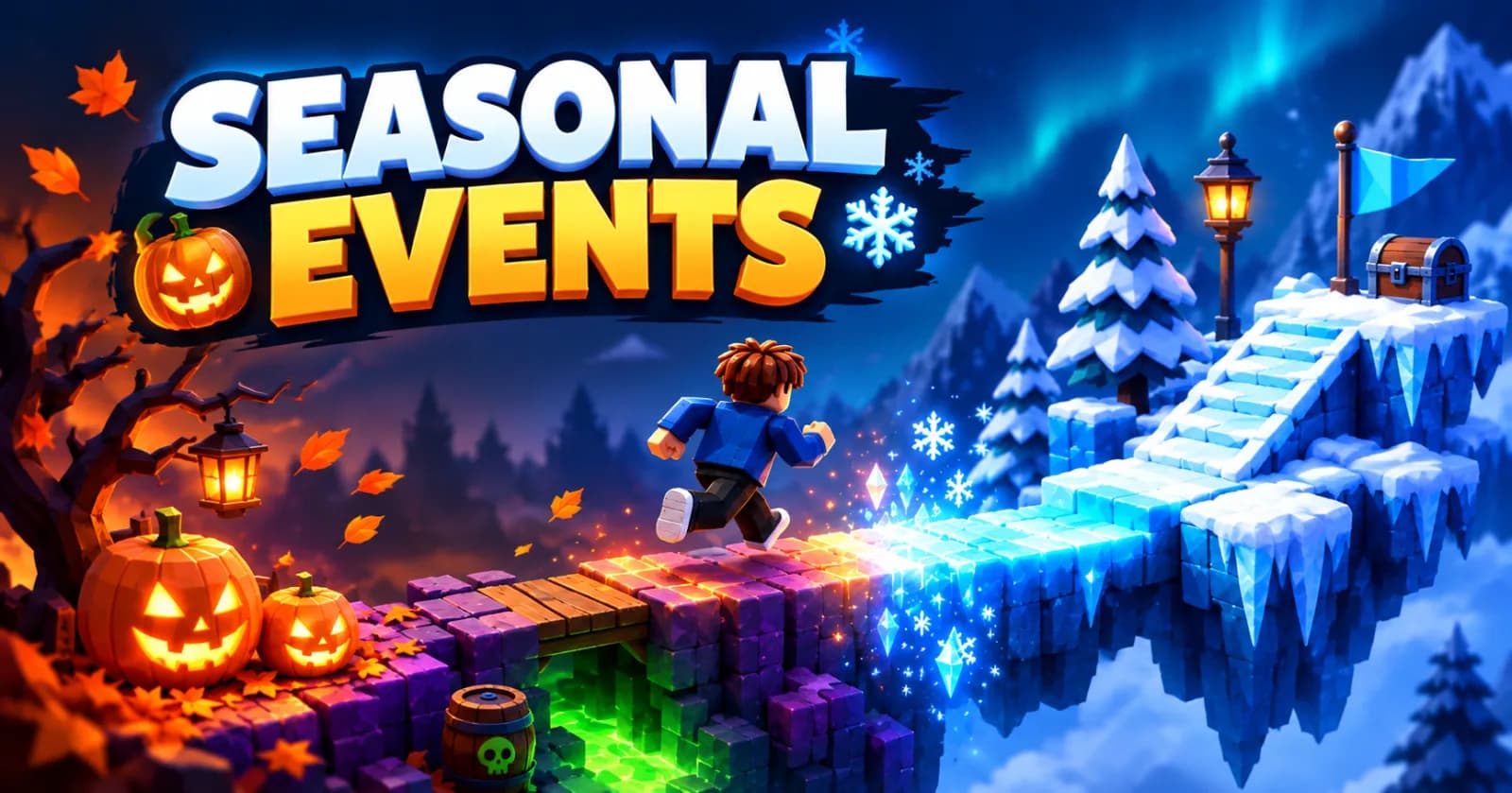
Four ideas, one per season
Start with a single event: familiar mechanic + a small challenge + a clear reward. Treat it as a hypothesis to test, not a guaranteed revenue lift. Pick holidays and timing to fit the countries and ages of your audience.
Pumpkin route
A standalone obby with toxic goo instead of lava and falling pumpkins. Landing spots are marked in advance so the challenge stays fair.
Reward: a pumpkin hat. Paid: a decorative trail of bats.
Ice track
A short route with momentum and safe braking zones. A practice stretch first to get used to sliding, then the obstacles.
Reward: a winter hat. Paid: a snow trail that doesn't touch the physics.
Blooming-garden hunt
Hidden items and hints appear on a familiar map. The player explores the usual route, collects a set, and earns a wreath.
Reward: a flower wreath. Paid: character styling — never hints you can't finish without.
Beach challenge
An obstacle course on existing platforms: a pier, umbrellas, and moving pontoons. No new swimming physics required.
Reward: a sun hat. Paid: a water trail behind the character.
What others have already done
Three confirmed examples from major studios. The ideas in this guide illustrate an approach — they are not guaranteed results for these companies.
Clash of Clans — a goal inside the game you already play
The Cookie Rumble event ran from 18 December 2023 to 1 January 2024. Players collected Sweet Elixir, including in ordinary attacks, earned medals, and traded them for decorations, a skin, and other rewards. There were free and paid tracks.
Takeaway:A new event goal can lean on the existing gameplay loop — you don't have to invent a separate mode.
Call of Duty: Mobile — the holiday becomes an action
In December 2023, Battle Royale players planted, fertilized, and decorated a tree for rewards. And in the Lunar New Year event (28 January 2022) there was a dedicated zone: on a floating platform you could only throw snowballs at each other; normal weapons unlocked once you left.
Takeaway:Carve out a small area with a festive rule instead of changing the whole game — for example, hitting targets with snowballs.
Cats & Soup — a festive forest and a reward collection
In December 2025 the game added a Christmas forest theme with effects, NPCs, and hidden easter eggs. Players gathered candy in the forest, and collecting it opened a shop of limited costumes. Login rewards ran too.
Takeaway:Tie the theming to item collection and a cosmetic reward. For a first test, one chain is enough: find items on a familiar map, earn a costume.
Planning one event
Fill in a short brief first. The example below is made up — dates and budget are yours to set. Event: “Ice route,” a standalone track for 14 days. Goal: measure participation of current players and their return after the event. Rewards: a hat for finishing; a snow trail as a purchase. Constraint: one track on existing controls, no rebuild of the core game.
Before launch
- Progress, granted rewards, and purchases survive a restart.
- Re-granting a reward and logging in from an old game version are tested.
- Someone owns the launch; a kill switch and an error message are ready.
After it ends
- The entry closes cleanly; rules for claiming leftover rewards are clear in advance.
- Earned and purchased items work without the event scene.
- Results and notes are saved for the next run.
Prepare the new build early. For apps on Google Play, plan at least a week between submitting for review and going live — sometimes more. This lead time doesn't apply to web platforms.
Deciding whether to run it again
Don't stop at total sessions. Before launch, instrument the event start, its end, and reward grants — otherwise there's nothing to judge. What follows is a suggested scheme, not an industry benchmark.
| Metric | How to count / what to check |
|---|---|
| Completion | Finishers ÷ starters. Where do most players give up? |
| Return | Share of participants who came back within a set window after the event — say, 7 days. |
| Monetization | Cosmetic buyers ÷ players who saw the offer. |
| Cost | Team hours, assets, testing, and support. |
Compare the same weekdays and similar player groups. A UA spike, a holiday, or another patch could move the numbers. Event participants may be more active to begin with — that comparison alone doesn't prove the event caused anything.
Sources
- [1] Supercell · Cookie Rumble · 18 Dec 2023
- [2] Activision · COD Mobile: Siren Song · 4 Dec 2023
- [3] NEOWIZ GameOn · Cats & Soup: Christmas · 4 Dec 2025
- [4] Google Play · review and managed publishing
- [5] GameAnalytics · 2026 benchmark on 2025 data
- [6] Activision · COD Mobile: Lunar New Year · 28 Jan 2022